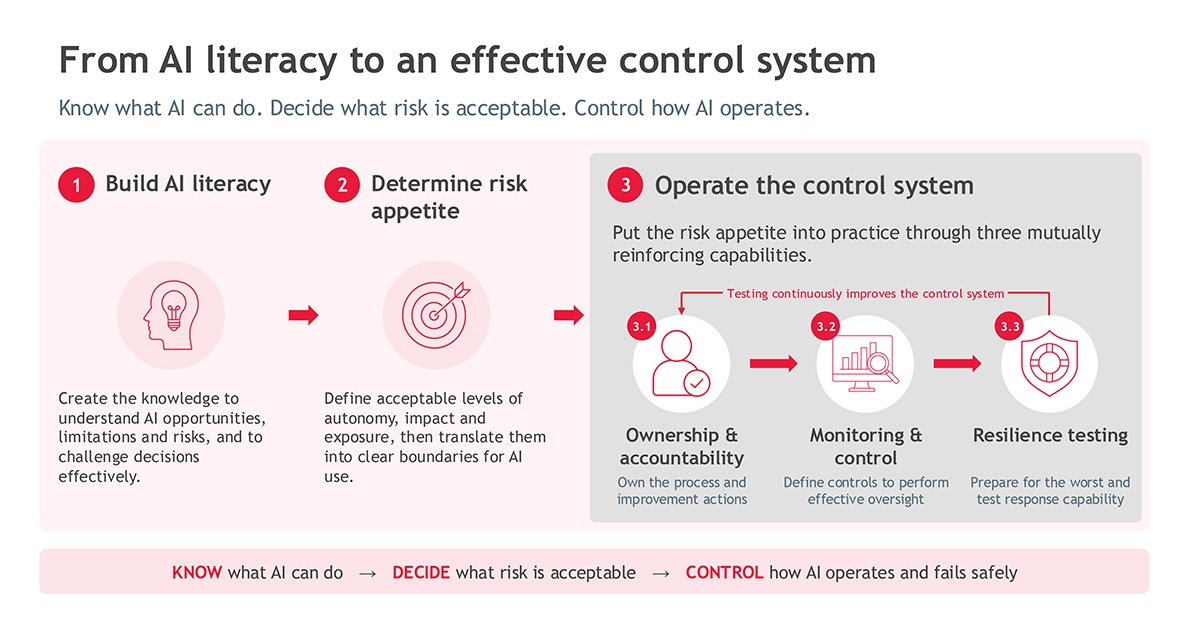

AI is no longer limited to experiments and proof of concepts. It is already part of how organisations make decisions, serve customers, operate, compete, and grow. However, its growing role also creates risk. Data exposure, flawed decisions, biased outcomes, non-transparent vendors, cyber weaknesses, regulatory challenges, and reputational damage can all escalate at machine speed.
The winning move is disciplined ambition: governance that lets low-risk AI move fast and requires high-risk AI to prove it can be trusted.
What the law requires
The evolving regulatory landscape increasingly requires organisations to establish clear accountability, oversight, and control over AI systems.
The EU AI Act introduces obligations that depend on an organisation's risk level and role, whether as a provider, deployer, importer, or distributor of AI systems. Boards do not need to manage these obligations directly, but they should ensure management understands which responsibilities apply and how compliance is being achieved.
As AI capabilities continue to evolve, organisations should also define clear decision authority for increasingly autonomous AI systems and AI agents. Boards should understand which decisions may be supported by AI, which actions may be executed autonomously, and where human oversight remains mandatory.
The key question now is whether accountability, oversight, and decision authority remain clear as AI becomes more embedded in business processes.