

Weak AI governance not only creates compliance exposure. It also leads to poor outputs, wasted budget and lost trust. And trust, once questioned, is hard to rebuild. Getting your governance right changes that. It makes AI programmes more reliable, scalable and valuable.
Here’s what you can expect if you properly govern your AI systems:
This way, AI governance becomes a precondition for scaling AI with impact and makes your investments deliver true value.
Perspective 1: AI enabled service providers
Extending assurance, not starting from scratch
If you’re a service provider, chances are you already have a solid control environment in place. The opportunity with AI is to build on it, rather than launching a separate AI compliance programme on the side.
Frameworks like ISAE 3402, SOC 2 and ISO/IEC 27001 were not built with AI-driven decision making in mind. They cover information security, availability, confidentiality. Solid foundations. But AI brings risks they weren’t designed to catch:
These risks sit on top of your existing requirements. The work ahead is evolving your control environment, not rebuilding it.
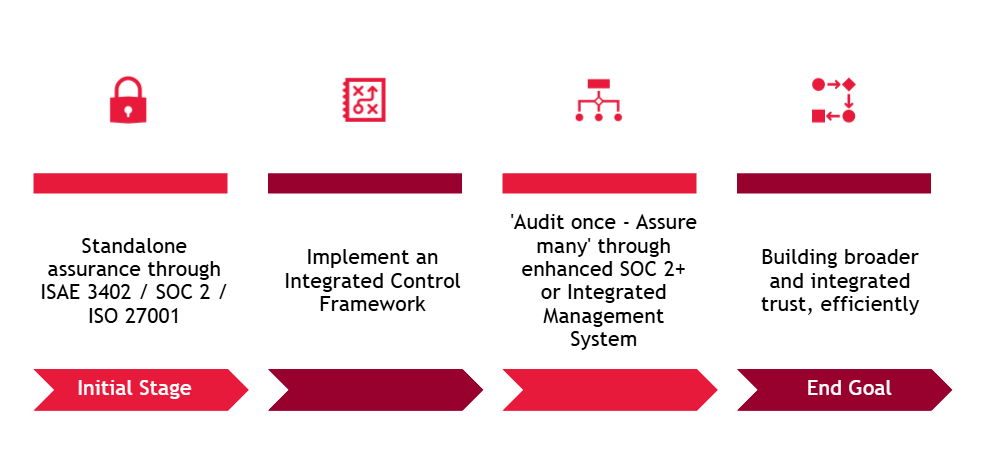
From SOC 2 to SOC 2+
SOC 2 has become a baseline expectation for technology service providers. Your customers expect it. But as AI becomes central to how your platform works, they’re starting to ask questions that SOC 2 alone doesn’t answer.
A SOC 2+ approach lets you go further without throwing out what you’ve built. You keep the SOC 2 structure and reporting model, layer in AI-specific requirements or additional regulatory standards, and avoid running fragmented audits with duplicated control testing.
The result is a single, coherent report that speaks to what your customers and regulators are now asking for.
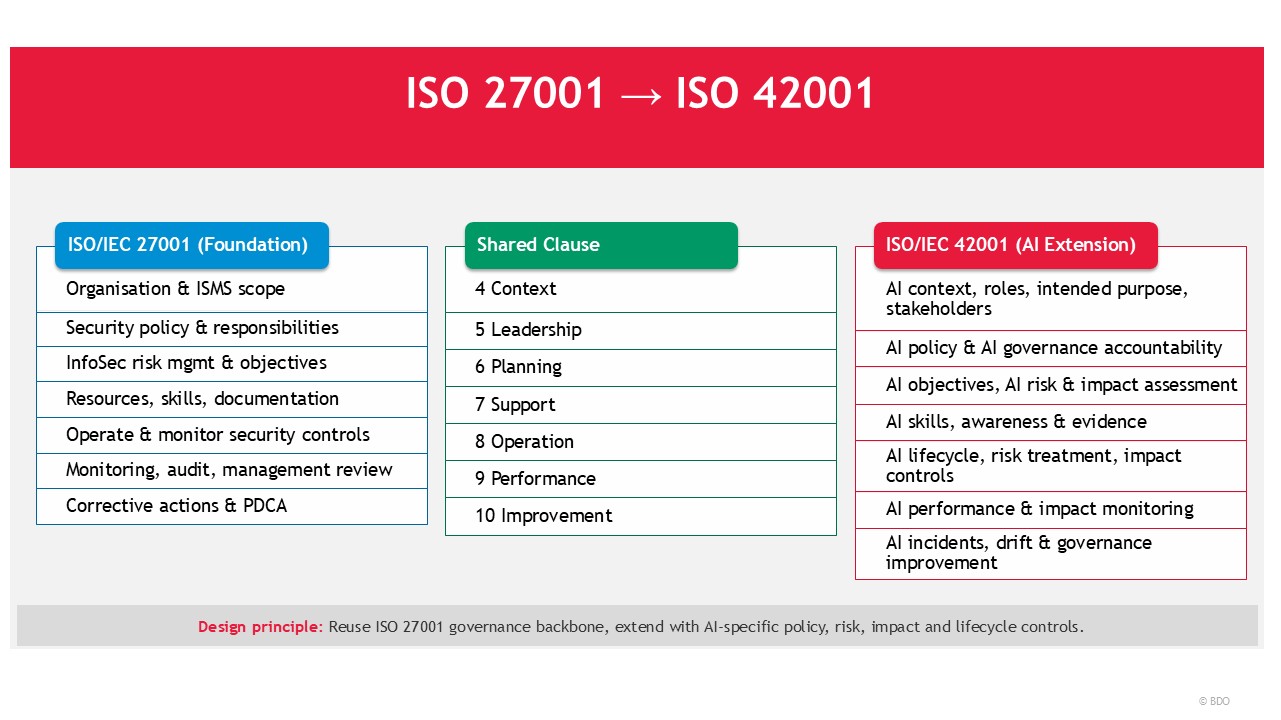
ISO 27001 as a foundation for ISO 42001
If you’re already certified against ISO 27001, you’re closer to ISO 42001 than you might think. The standard is designed to align with existing ISO management systems. The structure, the clauses, the way requirements are organised… it all maps closely to what you already know.
That means you can extend your existing management system rather than building something separate. One integrated framework covering information security and AI governance, without the overhead of running two parallel systems.
ISO 42001 introduces requirements focused on:
If you are already working within the ISO ecosystem, this is a logical next step for you.
Perspective 2: AI users
Proactively demonstrating governance
Using an AI system instead of building one doesn’t mean you’re off the hook. If your organisation relies on AI-powered services or procures AI tools, you’re still expected to show what’s being used and why, and how you’re managing the risks.
Our advice: lean on your vendors for this. Their SOC 2+ reports or ISO 42001 certifications give you something to point to. But they don’t replace your own governance. Regulators, clients and partners want to see that you’re making deliberate choices, not just delegating accountability.
Governance beyond policies
A policy document on responsible AI use is a start, yet it’s rarely enough on its own.
The stakeholders asking questions today want real transparency. Where is AI being used in your organisation? How are risks assessed before AI deployment? What happens when something goes wrong? How are people’s rights protected?
These are fair questions. And having credible answers to them is what separates organisations that are in control from those that are hoping nothing goes wrong.
How BDO can help
AI adoption is accelerating across every sector. What will set your organisation apart is how credibly you can show you govern it
BDO can help across the full spectrum of the ecosystem. We help service organisations extend their existing assurance and certification frameworks. And we help AI user organisations take a clear-eyed look at their governance, risk and compliance posture.
If you want to know where you stand and what makes sense as a next step, we’re here to talk this through with you.

Our AI Maturity Assessment gives you the foundation to build that assurance, before an audit or assurance process.